Age alone does not make a Sicilian ceramic worth more, and a new piece is not automatically the safer buy. What collectors compare is the glaze, whether the decoration was fired or painted cold, the condition of the body, and the story behind the mark on the base. We have made majolica in Caltagirone since 2002 and handle old pieces every week, so this is what we check, and what we would tell a friend before they spend money on either.
What “vintage” means for Sicilian ceramics
In the trade, “vintage” usually means 20 to 30 years old or more, and “antique” means a century or more. For Caltagirone, that puts most of what is sold as vintage Italian ceramics between the 1950s and the 1990s. Those decades were not uniform. The 142 steps of Santa Maria del Monte were faced with majolica tiles in 1954, tourism grew, and dozens of small workshops opened to feed it. Some of that output was wheel-thrown and painted on raw glaze the traditional way. Some was made fast for souvenir stalls. A 1970s plate can be better made than a 1930s one, so the date is only a starting point. How the piece was made is written in the glaze.
Reading the glaze: fired decoration or cold paint
Traditional Caltagirone majolica is earthenware covered with an opaque white tin glaze. The painter works on the raw, unfired glaze, which drinks the brush like blotting paper, and the piece goes back into the kiln so the colors melt into the surface. We bisque fire at about 1000°C (roughly 1830°F) and glaze fire at 920 to 980°C (about 1690 to 1800°F). A full cycle with cooling takes us close to 24 hours. Colors fired this way sit inside the glaze. Run a fingernail over a cobalt line and you feel almost nothing.
Cold-painted pieces are different. The decoration went on after the last firing with paint that was never fired, sometimes over a plain white glaze, sometimes over bare terracotta and varnish. It was the quick way to make tourist ware, and plenty survives from the 1960s and 1970s. The signs:
- Color that sits on top. Cold paint has a slight ridge and a different sheen from the glaze around it. Fired color has the same surface as the white.
- Wear on the high points. Rims, handles, and the tips of a Moor’s head crown lose cold paint first and show white or terracotta underneath.
- Colors outside the palette. Fired Caltagirone work runs on cobalt blue, copper green, antimony yellow, orange, and manganese brown. Bright pink, pure purple, or metallic gold on a supposedly old piece deserve a closer look.
Cold-painted pieces are not fakes, and some people collect them. Just do not pay fired-majolica money for them, and never eat off them.
Crazing: what it proves and what it does not
Crazing is the fine network of cracks in an old glaze. It happens when the glaze shrinks more than the clay body, and it can appear the day a piece is made or forty years later as the body slowly takes in moisture. Old tin glazes on porous earthenware craze often, so collectors read it as age. It is not proof. We have seen new pieces craze within months because the glaze did not fit the clay, and we have handled 1960s plates with a perfect surface.
Harder to fake is the dirt in the lines. Decades of handling leave gray or brown staining inside the crazing, heaviest where hands touched the piece and lightest under the foot. Uniform tea-colored crazing everywhere, including inside the foot ring, usually means someone helped it along.
Lead: the question to ask first
Until the 1980s most Italian majolica glazes were lead-based. Lead makes a glaze melt lower and flow smoother, and nobody in a 1960s workshop was testing what leached into the vinegar on a salad plate. European limits on lead release from tableware date from 1984, and older pieces were never subject to them. Acidic food, hot liquids, and worn or crazed glaze all increase leaching.
We use lead-free glazes for everything we make, and we treat any vintage piece as decorative unless a lab has tested it. Home swab kits can flag a badly leaching piece, but a clean swab is not a guarantee. If you want a platter for Sunday dinner, buy new. If you want a 1970s albarello for the mantel, the lead question does not apply.
Marks and signatures: what they actually prove
Turn the piece over. Most Caltagirone majolica from the last 70 years carries something on the base: the word “Caltagirone,” a workshop name, a painter’s initials, sometimes a year. On older pieces the mark is usually hand-written in manganese or cobalt with the same brush used on the front. Rubber stamps and printed labels came later.
Here is the uncomfortable part. A mark tells you what the maker wanted you to read. Anyone with a brush can write “Caltagirone” on a plate made anywhere, and decal-decorated ware from outside Sicily has been sold with hand-lettered Sicilian marks for decades. The tests in our guide to identifying authentic Sicilian ceramics, brushwork, decal dots under a loupe, the bare clay of the foot ring, matter more than the signature.
Where a mark helps is attribution. If the workshop name matches a family known to be active in those years and the painting matches documented pieces, the mark supports the story. It never carries it alone. Ask for provenance in writing: where the piece was bought, when, and from whom. “From an Italian estate” is not provenance.
Condition: what to accept and when to walk away
Every old piece has wear. The question is where and how much. Rest a plate on your fingertips at the center and tap the rim with a knuckle. An intact piece rings. A cracked one gives a dull thud, even when the crack is invisible. Then check:
- Flea bites. Glaze chips of a millimeter or two on the rim or foot. Common, acceptable, and they should be priced in.
- Hairlines. Run a fingernail across any line you see. A crazing line will not catch. A hairline through the body will, and it will grow.
- Chips on the face. A chip that removes decoration on the front of a display plate matters far more than one under the foot.
- Restoration. Filled chips and overpaint often fluoresce differently under a UV flashlight. Ask for photos in raking light, with the lamp almost parallel to the surface, which shows fills and sanded areas.
- Reglued parts on sculpture. On a Moor’s head, the crown, earrings, and the tips of leaves and fruit break first. Repairs are common and fine if disclosed.
A piece with a hairline can still be a good buy if it is rare and priced for it. Undisclosed restoration is the reason to walk away, because it tells you what else was not mentioned.
The forms collectors chase, and the sizes that matter
Some shapes fill the vintage market. Others are scarce and get attention when they appear.
- Teste di Moro. The most collected Sicilian form right now, and the most reproduced. In our experience the 45 to 50 cm (18 to 20 inch) heads are a recent taste. Most older heads we have handled sit between 20 and 35 cm (8 to 14 inches), with simpler modeling and less fruit on the crown. For heads, how to tell a handmade testa di moro from a factory one goes through the signs one by one.
- Pigne. The pine cone that sits on gateposts and balconies as a sign of good fortune. Check the scales, which chip easily, and the base, which is often ground flat after a warped firing.
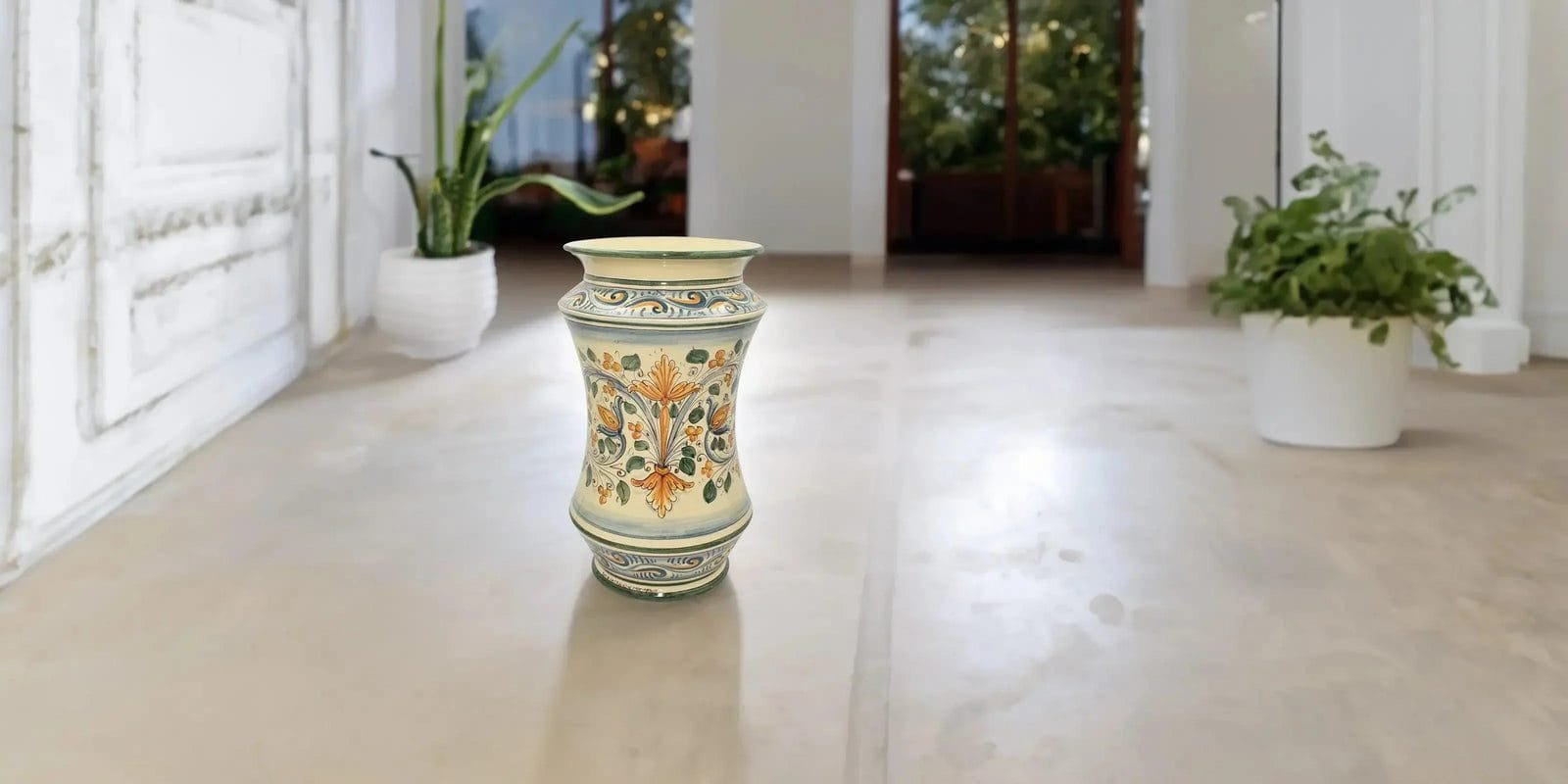
- Albarelli. Waisted pharmacy jars. Caltagirone made them for real pharmacies for centuries, so 20th-century reproductions are everywhere and pre-1900 examples are not. Treat any claim of great age with skepticism unless there is documentation.
- Piatti da parata. Display plates of 30 to 40 cm (12 to 16 inches) with a full painted scene or a dense border. They show the painter’s hand more than any other form, and attribution moves the value.
What a new piece gives you, and what it cannot
We make new pieces, so weigh this accordingly. A new piece from a working Caltagirone laboratorio gives you a lead-free glaze, a body with no hidden cracks, and a maker you can email. You can settle the size and palette before it is made instead of hunting for one. You can ask who painted it and get a name. Every piece we sell is checked on the bench after the second firing, and firing defects do not leave the shop.
What a new piece cannot give you is time: no dirt in the crazing, no softening from decades of hands, no story of the balcony it sat on in Palermo. It also cannot match the product photo exactly. Hand-painted majolica varies from piece to piece. The leaves on a border come out slightly different every time, the blue pools thicker in one place than another, and a painter who did twenty plates on Monday will paint the twenty-first a little differently on Tuesday. If you want two plates that match to the millimeter, you want printed ware, which is a legitimate choice and a different product.
Some new production imitates age on purpose, with sponged brown stain, forced crazing, or a distressed foot. Sold as “antiqued,” that is fine. Sold as vintage, it is fraud, and the same tests catch it.
Six questions to ask any seller
- Can I see the base in daylight? You want the foot ring, the mark, and the color of the bare clay.
- Was the decoration fired? If the seller does not know, ask whether a damp cloth lifts any color. On fired majolica it will not.
- Has it been tested for lead? Decide what you are buying: a decorative object or tableware.
- Does it ring? A seller who handles ceramics will know what you mean.
- Any repairs, and can I see it under UV? Silence here is an answer.
- Where did it come from, in writing? A receipt from a Sicilian shop in 1978 is worth more than a paragraph of adjectives.
If the answers hold, buy the piece you love. If they do not, the piece will still exist next month, and so will the workshops in Caltagirone making the ones collectors will chase in forty years.
Frequently asked questions
Is it safe to eat from vintage Italian ceramics?
Not without testing. Most Italian majolica made before the mid-1980s used lead-based glazes, and crazing or worn glaze increases leaching, especially with acidic or hot food. Use old pieces for display unless a laboratory test says otherwise.
Does crazing prove that a piece is old?
No. Crazing is a glaze-fit problem that can show up in a new piece within months. Dirt trapped in the lines, heavier where the piece was handled and lighter under the foot, is a better sign of real age, though it can be faked with stain.
If the base says “Caltagirone,” is it really from Caltagirone?
Not necessarily. A hand-written mark can be added to any piece, and decal-decorated ware from outside Sicily has carried Sicilian marks for decades. Judge the brushwork, the foot ring, and the way the color sits in the glaze before you trust the signature.
Will a new hand-painted piece look exactly like the product photo?
No, and it should not. Painting on raw glaze cannot be repeated to the millimeter, so leaves, borders, and the density of the blue vary from piece to piece. The form, size, and palette will match. The brushwork will be that piece’s own.